
One of the most important roles at a tech startup is a software engineer. In order to create your product and websites to appeal to both investors and consumers, you’ll need a skilled software engineer on the team.
Most startup founders are tasked with hiring in the beginning stages of their company. If you’re wondering how to hire your first engineer, we’ve created a guide to the interview process and beyond to ensure you’re hiring the best engineers to build your startup. Given that we’ve helped companies hire over 6 million candidates, we know a thing or two about how to find the perfect match.
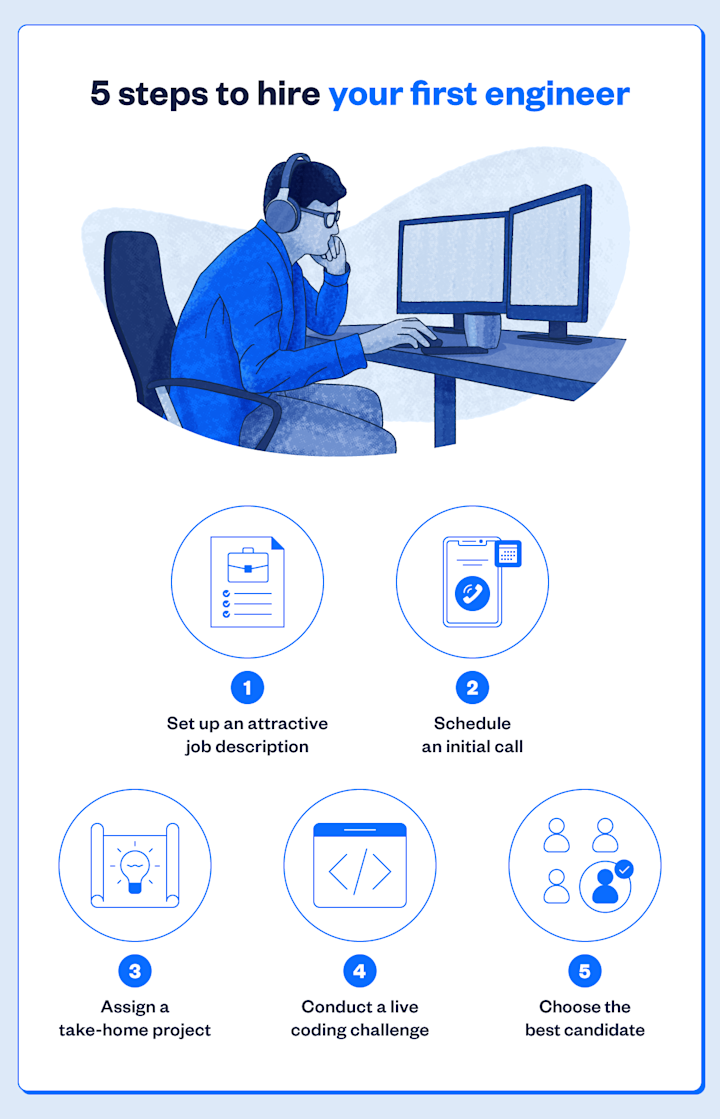
1. Set up an attractive job description
When looking to recruit engineers you must first have qualified candidates apply. Start by drafting an inviting job description that keeps the job seeker engaged from headline to resume submission.
Here’s how to recruit your first engineer with an attractive job description:
- Set clear expectations. Go into detail on job roles, responsibilities, qualifications, and the salary for the engineer position.
- Make your company stand out. These days, job seekers are putting more stock in company culture, so discussing inclusivity, perks, and anything else that makes your employees feel valued is encouraged.
- Talk about growth opportunities. Because you’re hiring your first engineer, discussing a career path and their potential future roles can excite job seekers and entice them to apply.
- Leave out tired buzzwords. Terms like “rockstar” or “ninja” aren’t as clever as you may think. Traditional vocabulary is easily understood and digestible.
- Avoid gendered language. Some words are gender-biased, like “analytical” (male) and “understanding” (female). Eliminating this gender-coded language will encourage even more people to apply.
- Review the job description for errors. Perfect spelling and grammar will make your company more credible.
When the job description is ready, create your company profile on Wellfound, post it on the job board, and start collecting applications.
2. Schedule an initial call
Once you have collected enough applications, schedule an initial screening call with the most qualified software engineer prospects. This vetting process allows you to speak with candidates about their experiences and connect their personalities with their resumes. The candidates with the most potential can then be moved to the next stage of the interview process.
Here are some popular topics you could discuss when interviewing an engineer:
- Ask how comfortable they are working for a startup.
- Ask about recent projects they have worked on, their role, and their decision-making processes on those projects.
- Ask how they stay current on industry trends.
- Ask them to describe their preferred work environment.
3. Assign a take-home project
A take-home project is a fantastic way to assess an engineer’s technical knowledge by allowing them to demonstrate their talents and creativity.
For example, you can ask the candidate to do a technical brief for a new feature they want to build for your company. This is company-specific and shows how they think within the scope of the business and what they could potentially contribute.
It is essential that the candidate writes the code with minimal oversight, though someone should be available if needed. Have the candidate ask simple questions through email, or if they require in-depth help, the interviewer can accommodate a call. Once completed, ask them to explain the feature and document how they would add it, including delivery, technical risks, and trade-offs.
4. Conduct a live coding challenge
A live coding challenge is an exercise that demonstrates your candidate's programming skills in real time. You can use video apps like Zoom or Google Meet to administer the challenge, so you can also assess how well the engineer works in a remote environment.
Candidates can use the Github codebase that is already written. Ask them to add a feature to the existing code and to describe the details as they write the code. The benefit of this challenge is two-fold; it showcases the candidate’s technical talents while also recreating a work environment that displays their soft skills. This shows if they are someone you can work with.
5. Choose the best candidate
Once you have assessed the coding projects, be prepared to satisfy the candidate’s questions with quality answers. The more questions the candidate asks (and the more in-depth they are), the more you can determine how eager they are to learn about the position. A few examples of these questions are:
- What is the work environment on the team?
- What tech stack does the company use?
- What is the business plan for the company?
- What does the product delivery process look like?
Hiring an engineer is a symbiotic process and their questions can help you separate the top engineering talent from the rest of the field.
Common red flags to look out for
The process on how to find an engineer with qualities that align with your company may include weeding out candidates that show warning signs or tendencies of bad habits in their interview. Keep an eye out for red flags that could mean the candidate might not be the best fit for your team.
- Short answers with minimal detail could point to disinterest in the role or passion for the trade.
- Difficulty answering fundamental engineering questions could mean they aren’t as seasoned or knowledgeable as you’d prefer.
- Any form of aggression or dismissive attitude could be a common occurrence that develops into a toxic work environment.
Hiring engineers: interview best practices
Before you meet with any potential engineers for the position, ensure you have a solid interview structure in place. Adhering to the best interviewing practices of how to hire a founding engineer can help streamline the process and maximize your odds of finding the right candidate.
Ask multi-part questions
Some of the best questions when hiring an engineer are those with multiple parts. Avoid asking overly difficult or trick questions. You’re looking for a knowledgeable answer with thoughtful follow-ups that will give you insight into their skills and critical thinking. Some examples include:
- Discuss a challenging engineering project you were involved with and how you ensured it was a success.
- Do you have safety procedures in place to check your work? Explain each procedure and how they help you avoid missing mistakes.
- Which programming languages do you prefer? Explain why.
Focus on code reading
Reading code is an interview tactic that allows founders to cover a lot of ground quickly without spending more than a couple of minutes per problem. Print out 10-15 code snippets including UNIX commands, regular expressions, and SQL queries. Then, you can ask questions like:
- What does this snippet do?
- How does it work?
- Are there any bugs?
Conduct an empathy interview
After understanding the candidate’s technical skills, the interview should pivot from product-specific questions to those that discuss behaviors, motivations, and feelings behind their actions and problem-solving. This is called an empathy interview. Here are common empathy interview question examples:
- What inspires you?
- How do you measure success?
- In which type of environment do you thrive the most?
Before asking these questions, let the candidate know that there are no right or wrong answers. You’re looking for genuine responses that let you tap into emotions and empathy that will be helpful for the end-users of your product as well as tendencies while working with a team. Let the candidate drive the conversation and ask follow-ups if you need more information or clarity.
Prioritize asynchronous communication
Asynchronous communication is a crucial part of working autonomously. Ask the candidate to prepare a technical design document detailing the use, functionality, or architecture of the product. Then ask them to write feedback on a pull request.
This exercise helps you understand their communication style while working remotely and if they are giving enough clear, concise information for their team.
Reduce interview stress
High-stress interviews can create an environment where the candidate may not be able to perform at their best. Reducing stress will allow the candidate to think more clearly and creatively. Here are a few strategies that can help reduce stress during interviews:
- Create an information sheet and attach it to the interview email and calendar invite to reduce uncertainty and sell the opportunity. Your information sheet should include what the company is looking for in an engineer, why the engineering role is interesting, who the engineer will speak with, how the company interviews, and frequently asked questions from candidates.
- Add a 15-minute window between back-to-back interviews to give candidates a break.
- Spend the first five minutes of the interview getting to know the candidate and reducing everyone’s stress levels. Adding a human element builds rapport and reduces everyone's nerves.
- Allocate 10 minutes at the interview for the interviewer to sell the opportunity to the candidate.
- Reduce uncertainty by providing information on the people the candidate will be speaking to in the email and calendar invite.
- Treat the coding interviews as a pair programming exercise and make sure the interviewer is trained to do so.
Using these tips can help create a relaxed environment for each candidate to showcase their talents instead of an anxious situation that could skew results of how they may perform in the live project situations.
Top tips for hiring engineers
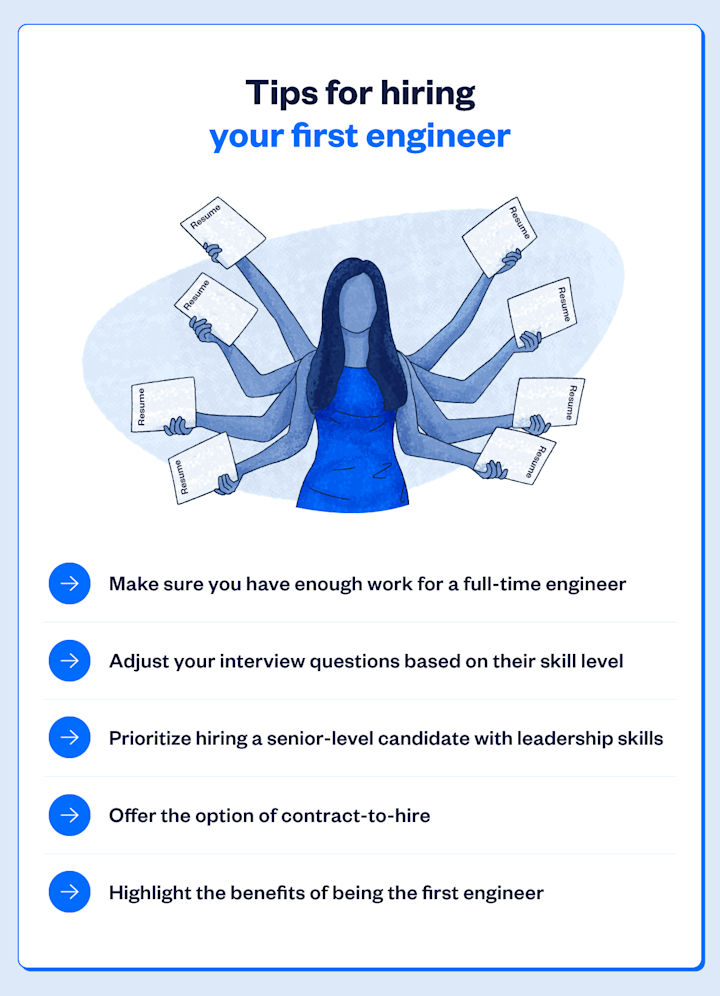
With software engineers in such high demand, you still want to make the right hire and not a hasty decision. These top tips on how to hire an engineer will help you pick the right person for the role.
Make sure you have enough work for the engineer
Not every project is ready to break ground when the software engineer is ready to enter the fold. You may need to comb through projects and divide them into smaller pieces to keep the engineer stocked with work.
Considerations for senior vs. junior engineers
Depending on the experience of the engineer, you may need to tailor your approach to their skill level. If the candidate has a tenured history or has been a senior engineer at other companies, you can ask more vague, open-ended questions.
Conversely, if their experience aligns more with a junior role, then a product manager who knows how to translate product requirements into technical projects for the engineer should work closely with the candidate.
Hire candidates with the right profile
Once you’ve interviewed the candidates and assessed their skills through various projects, it’s time to pick the best candidate for the position.
Ideally, you will want to hire a senior-level engineer with leadership skills and growth aspirations interested in future opportunities from tech lead to Chief Technology Officer. As your startup continues to grow, so will your engineering team, and your first engineer will ideally assume a natural leadership role. The engineer should also be able to explain and communicate effectively with both technical and non-technical colleagues.
Offer the option of contract-to-hire
Offering a startup engineer a contract-to-hire option offers more flexibility for both the employer and engineer. This type of contract allows both parties to work together in the short term to see how they mesh before committing to full-time employment. Both parties have the option to opt out at the end of the contract.
Call out the benefits of being the first engineer
Pitch the candidate the benefits of being the first engineer at your startup. This should be enticing to an engineer, as they will be able to take ownership, shaping and growing the role. Having free reign to create their vision is something that resonates with many engineers.
Starting on the right foot
The founding engineer of your company will have an integral role, so bringing in the right person is crucial. Knowing how to hire your first engineer and following these tips can put you in a position to make a top-tier hire that grows with your company.
To make your search even easier, use Wellfound to recruit the best engineers. With over 8 million startup-ready candidates in our database, you’ll be hiring your first engineer in no time.