Everyone knows that the earliest employees at early-stage startups are most often engineers. But what’s less obvious is when exactly a founder should make their first non-engineering hire — and what skill-set that individual should come with.
After pouring over 10,000+ AngelList Talent job postings and interviewing nearly 100 early-stage, venture-backed startups with the support of Crunchbase, our firm Basis Set, found that high-performing companies began hiring for non-engineering talent earlier than their lower-performing peers.
On average, high-performing startups displayed a decreasing concentration of engineers after the 6th employee, among the companies we surveyed. It’s easy to fall into the trap of believing that building more robust features is the key to product-market fit, but ultimately the most successful companies are the ones that are able to achieve team-problem fit, matching early hires with the critical opportunities a company must capitalize on to grow.

While there was some variation in this finding, particularly for engineering-heavy, deep-tech startups, overall, founders of high-performing startups were more likely to buck the dogma that more engineers is universally better. Once founders made the decision to hire non-engineering talent, we found that most high-performing startups tend to prioritize similar skill sets.
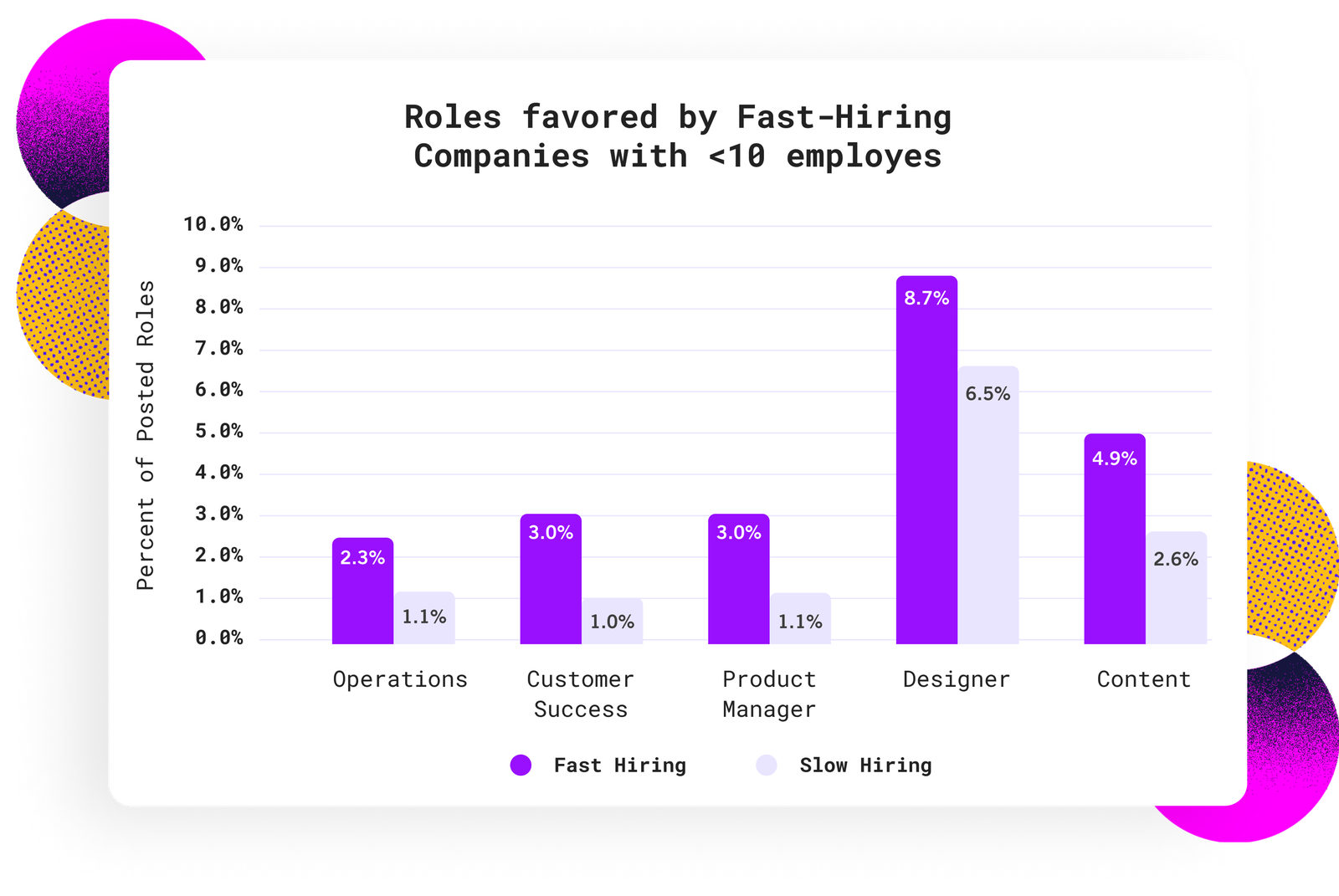
Among these high-performing companies, founders most disproportionately hired for content, design, product management, customer success and operations roles ahead of their lower-performing peers.
This finding fits with broader industry adoption of product-led growth strategies that rely heavily on robust execution across each of these functions. Interestingly, content was much more popular than other growth functions including SEO, social media and community management.
Check out the full report on the Basis Set website for more details on these findings and a breakdown of our methodology and definitions. In addition, we also share six common company archetypes for both high and low-performing businesses so founders can benchmark their own company’s key metrics and growth.
Our research is part of our larger effort to democratize growth through the Hypergrowth Network by giving founders access to the strongest data, mentorship and custom-built tools.