Our weekly tech newsletter. Subscribe today on our blog.
Quick Hits
Robots in Geneva: Humanoid robots take center stage to showcase their humanitarian potential to a U.N. audience.
Tax boost: Tax credits and incentives are a boon for EV sales in the U.S.
Generating unicorns: Two dozen generative AI startups now claim $1B+ valuations.
Boomerang effect: The striking down of affirmative action could hurt tech companies’ diversity efforts, experts worry.
Labor pains: Regulators find merit in a former employee’s case against Twitter over return-to-office mandate protests in California, leading to a settlement.
Ceasing censorship: Federal judge says “hands off” of social media platforms’ policing of speech.
On China’s nickel: China is greatly expanding its access to nickel for EV batteries.
The startup will see you now
A Swedish medical diagnostics company co-founded by a Spotify exec is bucking the trend toward telehealth and setting up physical health clinics. Neko Health raised $65M in venture capital to head to London with its clinics, which are tricked out with full-body 3D scanners that can detect all manner of ailments, from skin conditions to early warnings about heart health.
Lawyers seeking engineers
Law firms across the globe are hiring tech talent for roles like AI manager. The generative AI revolution put the industry’s talent search into overdrive in recent months. Firms are hiring software teams to figure out how to best use AI and machine learning to please ever-demanding clients. The University of Liverpool now offers modules to train students on using cutting edge lawtech tools. “Competition for lawtech talent is fierce and has been for some time,” an exec told Bloomberg.
Grylls: Computer literacy can save your life
TV adventurer Bear Grylls says digital literacy is a key survival skill for today’s youth. He’s partnering with startup Seekr to help connect young people to reliable, bias-free news and lead them on digital humanitarian “missions.” Seekr uses natural language processing and AI to evaluate content for reliability and political bias, so that people can access trustworthy information.
Skills shakeup for ‘knowledge workers’
Half of the U.S. workers are so-called “knowledge workers.” Now that AI is able to pass a medical exam and provide a fairly convincing therapy session, they’re paying more attention to AI and its potential implications. Experts expect this generation’s “skills-based technological change” to reshuffle roles just as others did to the factory floor and call center. Automation eliminates the need for some roles while creating new opportunities at the top.
The Weekly Pulse
Tech talent remains in high demand
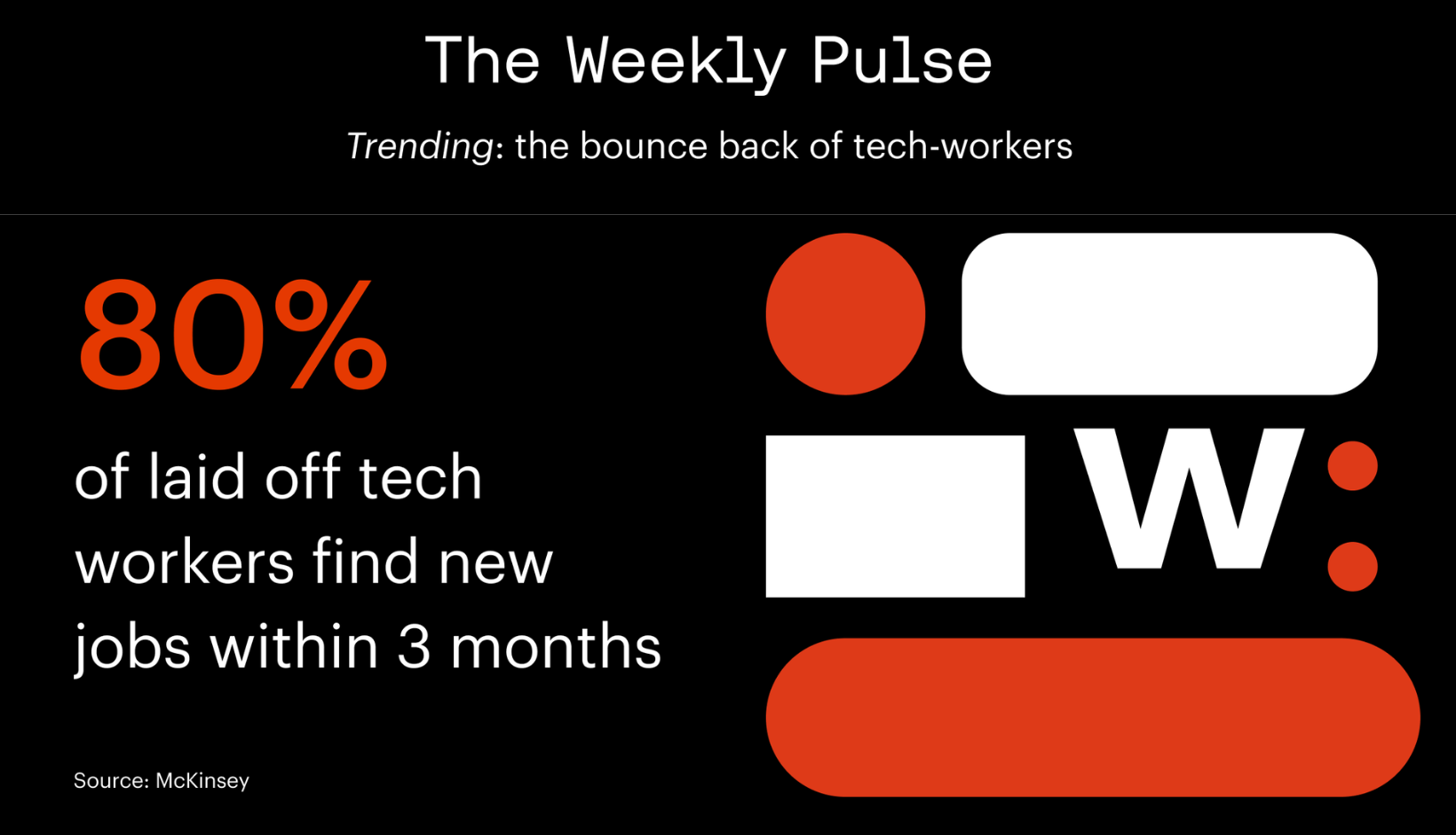
According to a recent McKinsey analysis, more than 80% of laid-off tech workers find new jobs within three months. Often, they’re headed to so-called “incumbent” companies that aren’t purely tech focused. “Technology firms are becoming a little less ‘techie,’ while incumbents are becoming more so,” according to the report.
Poll of the Week

Podcasts of the Week
The Economist Podcasts: Clone wars - Meta's Threads takes on Twitter
What We’re Reading
- AI Could Change How Blind People See the World (WIRED)
- Eric Schmidt: This is how AI will transform how science gets done (MIT)
- People Hire Phone Bots to Torture Telemarketers (WSJ)
- Google's quantum computer outpaces supercomputers by '47 years’ (Interesting Engineering)
- E2E encryption: Should big tech be able to read people's messages? (BBC)
- The rise and fall of Skype (CNBC)
- Reddit says new accessibility tools for moderators are coming. Mods are skeptical (NPR)
Startups Hiring Now
Camus Energy: SaaS open source grid management | 3 open roles
Vannevar Labs: Defense for the digital domain | 13 open roles
Stochastic: Making the best AI accessible to everyone | 4 open roles