In this From the Founders feature, we talk to Naushad UzZaman of Blackbird.AI. Read on to learn about Naushad's journey to starting Blackbird.AI, the team behind the scenes, and the company's mission to empower trust, safety, and integrity across the information ecosystem.
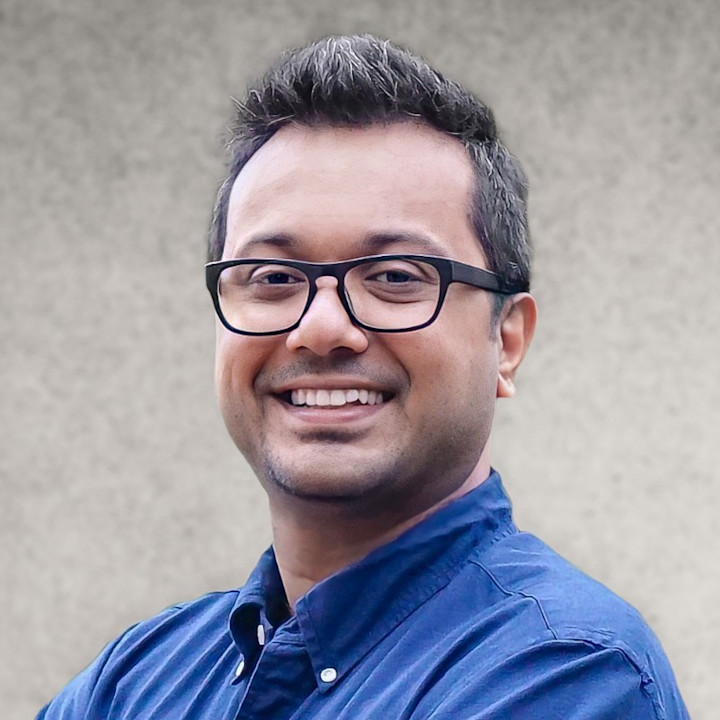
EV: First, can you introduce yourself and tell us more about Blackbird.AI?
NZ: I’m Naushad, Co-Founder and CTO of Blackbird.AI. We protect organizations from narrative attacks and cyber threats that cause financial and reputational harm.
The company aims to empower trust, safety, and integrity across the information ecosystem. We do that by protecting organizations from narrative attacks and cyber threats.
What we mean by narrative attacks is a new threat vector that organizations must contend with that they have no visibility of today. We define narrative as any assertion that shapes perception about a person, organization, place, or anything in the information ecosystem. The risk comes from the narrative attacks at scale and turns harmful, impacting the organization, corporation, and government and causing financial, reputational, and societal damage.
Cyber threats targeting the human mind and perception are the future of cyberattacks. We help organizations understand these narrative attacks and give them context so they can take necessary actions to mitigate the problems they're facing with the attacks.
EV: This is a massive problem to tackle. What is Blackbird.AI doing that is new in the space to help companies mitigate these risks?
NZ: One of the things we’re uniquely doing is what we call speed to insight. We built a solution that processes data in real time to give you an understanding of what's happening as it happens. If you have humans analyzing the data after two, three weeks, or months, you might have understood what happened, but the damage is already done by then. So first, speed to insight is critical.
Next is the fidelity of the insights. Many tools and data listening platforms give you some basic sentiment and understanding without getting too deep into what is happening in that conversation. But how we approach the problem uniquely is that through our Constellation AI-driven Narrative Intelligence Platform, we understand the narratives and who is pushing the narrative. How are they spreading it? Is it an organic conversation or a synthetic conversation? We provide that fidelity understanding to the organization, then build a solution towards automating the recommended mitigation strategy so they can be one step ahead of that foresight. That’s how we differentiate ourselves from all the other existing solutions in the market.
EV: You have a background in computer science. I’d love to hear how this idea came about for you. How did this become something that you specifically wanted to work on tackling?
NZ: So, my background is in computer science and AI. My co-founder and I have known each other for 15+ years, and we were trying to think of what we could do together with his business experience and my technical skills. We wanted to build something that had a positive social impact. In 2017, this was a problem that came to us that we knew was an existential problem and the biggest problem we could work on today. That’s how we jumped into tackling it, and we’ve been heads down working on it ever since.
EV: You’ve talked about your desire to make a positive social impact. It sounds like that was a significant motivating factor in your founder journey. What drives explicitly that for you?
NZ: I mentioned earlier that I'm originally from Bangladesh. When I came to the US for my grad studies, in my mind, I wanted to go back to Bangladesh to help people in my country. I’m very fortunate, but seeing many people in my country not have the same opportunities was always in my mind. That’s where it started, and then it transitioned into more. When I did my grad studies, my problem set was not just Bangladesh but something even more significant than that. It made me think about if I could do something with an even more substantial impact on the world and the society.
EV: I always ask founders what came first - the idea or know you wanted to start something one day. It sounds like, for you, it was the latter?
NZ: Yeah, I wanted to be a founder. I came to the US from Bangladesh, and I always fantasized about building a company, building a team, and building something positive for society, but I wasn’t sure when I would end up doing so. It came up while my wife, a medical student, was doing her residency then and was hardly home because of her work hours. I had a lot of time on my hands, so the timing for me, career-wise and age-wise, started to align. My co-founder also wanted to build something positive together. So that came first, and then the idea came afterward.
EV: Can you walk me through what that ideation stage looked like for you and your co-founder? At what point did everything click that this was the space you wanted to explore and the solution you wanted to build?
NZ: Great question. We had started building a solution before we pivoted to this solution. We were analyzing social media data and trying to rapidly detect harmful content like active shooters, terrorism, and natural disasters. When we looked into the data, we had a client in Harris County, Texas - the emergency response department for Hurricane Harvey. Our solution was in their command center. Then, when we were analyzing the data, we detected anomalies in our system that seemed like a propaganda network spreading false narratives. So, those early signs we saw told us there was an even bigger problem we could address. Many more propaganda campaigns were happening on something unrelated to this hurricane, and people were trying to jump in and spread more harmful narratives.
Then, when the Cambridge Analytica case came out, it was very eye-opening for us and everyone else that a lot was going on that we were just beginning to understand. We realized that narrative attacks and risk is the greatest existential threat over time, than all other threats. So that’s why we decided to end up working on this problem.
EV: I’d love to hear more about the team you mentioned, especially with work tackling a problem as big and impactful as this. Can you tell me about your personal hiring philosophy when building the team from the ground up?
NZ: Building a diverse, talented team is very personal to me. We want to hire mission-driven people who share the same vision as our founding team and get excited and feel lucky to work on this problem. In this competitive market, we can’t match the salaries and benefits these larger companies give. People often hop from one job to another unless they’re passionate about the problem. So, finding people passionate about working on the problem we’re solving is number one.
Number two is diversity of thought. We are working on a problem that impacts societies all across the globe, across all industries, from enterprise companies to national security to finance to supply chains. We can only solve the problem in a better way if we build a team where the majority of people are coming from all different backgrounds. We’ve built a team with a very diverse ethnic background - Bangladesh, Singapore, Korea, Japan, United Kingdom, France, Morocco, Algeria, Turkey, Australia, Brazil, Mexico, and of course United States - so a truly global team that’s also diverse from a technical background - National Security, Intelligence Community, Cyber Security, Wall St, Journalism, Public Health, Pure Science, Behavior Science, and a lot of people with Computer Science background. We tend to gravitate towards candidates with these diverse backgrounds. You’re always learning something from them and this helps us to become a much stronger team.
Lastly, we look for people with the mentality to push the boundaries. It’s not a nine-to-five job, in a way that this is an arms race. You can never get comfortable because there is never a satisfying solution. You need to think about the next challenge, the next threat. We always have to be uncomfortable, so we need people who thrive in that and want to work on that and push the boundaries.
EV: When it comes to hiring, what's been working so far?
NZ: We have a small internal team for helping with the recruitment process. In addition to our internal team, we have been working with you all at Wellfound to hire new talent. RecruiterCloud in particular has been very helpful for us when sourcing candidates.
EV: So you just raised a $20 million series B, and it sounds like you have exciting plans. You mentioned that this next phase is about going from 1 to 100, but to get there, you first had to get from zero to one. In that zero-to-one phase, what were some of the most significant turning points for the company that brought you there?
NZ: Instead of focusing on the specific company events, I want to focus primarily on the macro events that were out of our control. In recent years, many events have made it clear to our customers that this is not just a national security problem. It also impacts enterprise companies, such as COVID misinformation, Gamestop manipulation, MGM Grand Breach, and Silicon Valley Bank run losing billions of dollars based on public perception. The use cases keep coming one after another. These helped us explain the threat to our clients better. Many clients contacted us directly because they saw that their company or industry was at risk. So, the timing is the biggest thing that has helped us. When we started in 2017, we had to do a lot of explaining to investors when we were trying to raise money. Our clients would see a potential problem but didn’t know they needed it. These events made it clear that they needed a solution because this information was not accurate or false, black or white. It's not a question of right or wrong. Understanding how people perceive your company and how you should react is a matter of understanding. And the sooner you respond, the faster you can reduce the risk.
EV: My last question goes back to you as a founder. You've been doing this for several years now. You just raised your series B and have a team of 40 tackling a massive problem worldwide. What advice would you give if you were talking to someone who’s just getting started or wants to start their own thing one day?
NZ: Startups are a fun ride. But it takes a lot of perseverance, sacrifice, and passion. Companies drop at every startup stage, from seed to Series A, Series A to Series B, and so on, because it gets tricky. So, if you’re entrepreneurial-minded, I would strongly suggest exploring it and trying it, but it is difficult. Focus on the specific problem you’re trying to solve and be passionate about it because if you’re passionate about the work, you can get through, however hard it is.